
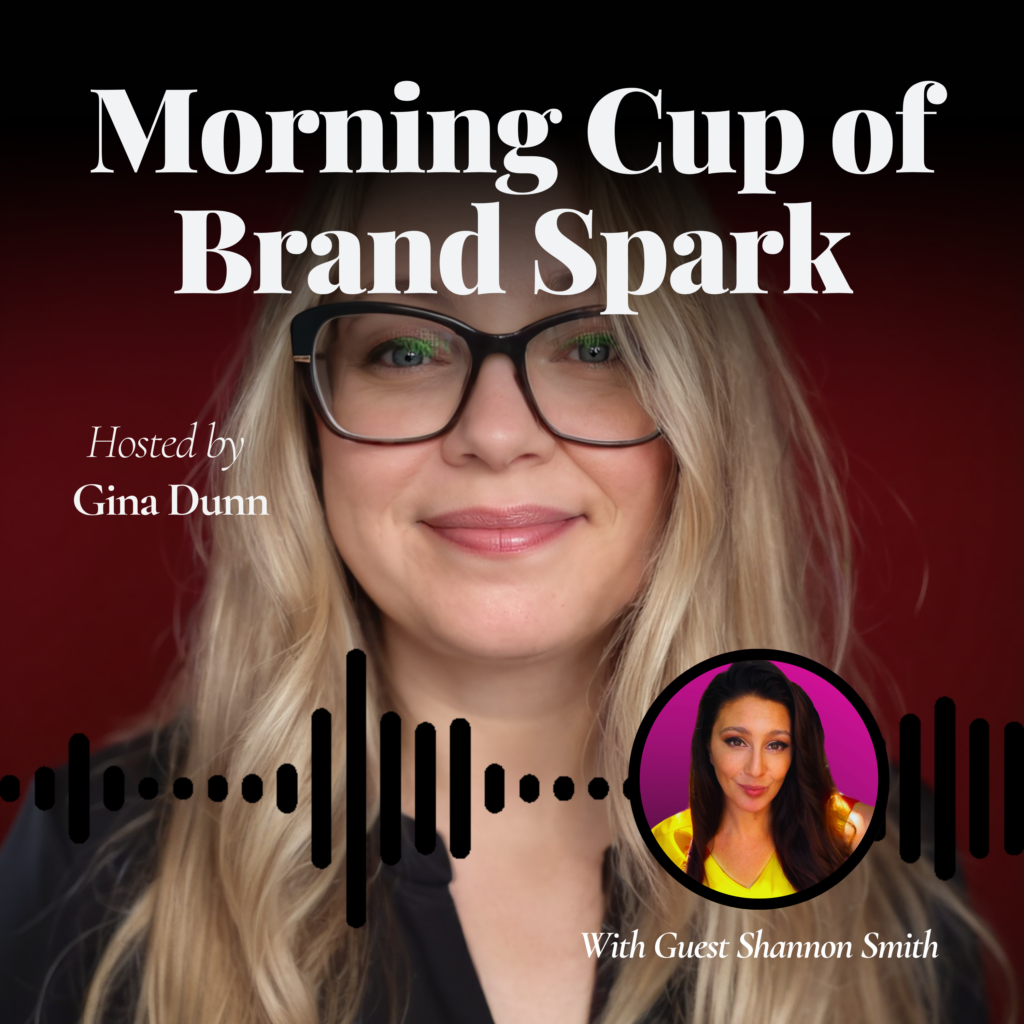
Ep 103 — When Strategy Stops Working — Shannon Smith on Anxiety, Neuroplasticity & Rewiring Your Brain
Episode Description (Podcast Platforms)
Burnout and reinvention don’t always look dramatic. Sometimes they look like anxiety, sleepless nights, and trying to hold everything together while the world shifts underneath you.
In this episode of Morning Cup of Brand Spark, Gina Dunn sits down with entrepreneur Shannon Smith for a conversation about the moment strategy stopped working and something deeper had to change.
During the pandemic, Shannon found herself living alone on a deteriorating boat in Seattle while trying to keep her business afloat. As anxiety, insomnia, and stress escalated, she turned to neuroscience not as a business tactic, but as a lifeline.
What she discovered about neuroplasticity and habit formation completely changed how she understood control, resilience, and the human brain.
Together Gina and Shannon explore how high achievers can regain clarity by understanding how their brains actually work.
This conversation is about more than productivity. It’s about reclaiming agency when everything feels uncertain. What happens when high performers quietly reach a breaking point Living alone on a failing boat during the pandemic while running a business The spiral of anxiety, sleeplessness, and over-reliance on coping habits Discovering neuroplasticity and the science of rewiring the brain Why most people misunderstand how long it actually takes to change a habit The power of understanding your own nervous system and thought patterns How neuroscience can help restore clarity and control during chaos Episode Takeaways -->
Your brain is not fixed.
Neuroplasticity means your thoughts, habits, and responses can be reshaped over time.
Most habit advice is wrong.
The common belief that habits form in 30 days is misleading. Research suggests the average is closer to 66 days.
High performers often suffer silently.
Stress and anxiety can build even when career and life appear to be working on the surface.
Understanding your brain changes how you approach challenges.
When you understand how thoughts reinforce neural pathways, you can actively reshape them.
Peace doesn’t always come from fixing the outside world.
Sometimes it comes from understanding how your brain responds to it.
About Shannon
Shannon Smith is a serial entrepreneur and neuroscience educator who helps people apply brain science to everyday challenges, from habit formation to leadership and sales.
After navigating a difficult period during the pandemic, Shannon immersed herself in neuroscience research and developed practical methods for applying neuroplasticity to real-world problems.
Today she works across multiple ventures including applied neuroscience education, sales strategy, and leadership tools designed to help professionals perform at their best while maintaining clarity and resilience.
Links:
Website
https://www.brainhacksbyshannon.com
LinkedIn
https://www.linkedin.com/in/shannonsmithjdms/
Additional resources mentioned in the episode: The Brain That Changes Itself — Norman Doidge If this conversation resonated with you, share it with someone who might need a reminder that clarity and control can be rebuilt.
And if you're enjoying Morning Cup of Brand Spark, follow the show and leave a review to help more listeners discover these conversations.
"You can dictate the makeup of your brain. You can rewire your own neural pathways. Having the ability and the power and the knowledge to shape that was extremely liberating."
Full transcript
Welcome back to Morning Cup of Brand Spark, the podcast where we slow things down and we explore the moments that change how we see ourselves. These aren't conversations about success always, not always about visibility either, or about getting it right. They're often about mirror moments. I'm talking about the reckoning, sometimes they're collapses, and all in all, they're the quiet decisions that shape who we become.
Today's conversation is about what happens when strategy stops working and regulation becomes the work. Let's welcome Shannon today.
Well, hello there, Shannon. Welcome to Morning Cup of Brand Spark. This is the mirror season. I am so happy to have you on today and we had such a blast the last 15 minutes, just meeting each other before this.
Yeah, Gina, I am stoked to be here with you today.
So.
Awesome. Well, before we get started, I have one little ritual question that I always ask. So what's in your cup today if you have a cup there?
Yes, currently I've got some Waterloo Watermelon Sparkly Water.
What is Waterloo? Is it a brand?
It's like, it's like a, it's like sugar-free. It's flavored water that's fizzy, that has gas and it's tasty without sugar and calories and all that jazz. So.
I have l-
⁓
yum, I have never heard of it. Have I been gone so long? Yes? Crap, I'm gonna come back. I'm visiting you, we already decided before this too. And I know where you're at, but can you tell the audience where you're joining from?
Yes, you need to come back for Waterloo.
Yes, we
Yeah, I am just outside of Seattle on Vashon Island. And I know this is super crazy, but it is foggy gray and rainy today.
You
Wait, is that normal? ⁓
Yeah, that's normal for winter for sure. Summer is a different
story, but yeah, winter, this is typical.
All right, well, let's jump right into it. I wanted to ask you a couple of questions about your story because it was intriguing to me. And you mentioned something about the pandemic. So what happened before the pandemic and during the pandemic that you wanted to talk about? Curious.
Yeah. So, I guess a little bit of idea of what was going on pre pandemic. So I had moved out to Seattle from Kansas City. I think I had been here for like four years at that point. And I got really, really lucky and had a big tech client for the firm that I created when I moved out there was just one of those times where you're in the right.
Yeah.
Okay.
time and the right place and everything just magically happened. So I had this huge tech client that I was serving and I was living with my partner at the time. And we had just decided that we were going to buy a 65 foot wooden boat, a saner, and he was going to completely remodel it to make it look like anything I wanted. So of course started a Pinterest board.
Mmm.
⁓
Ha ha.
And then we were going to sail
it up and down the West coast and get out of the gray, sunny winters. So everything was going really well. My career, love life, everything was in check. Community, the dog I had at the time, she just passed, but she and I were a service team. So we went into old folks homes and made people smile with their cool tricks.
You
Yeah.
Aww, cute.
And
then dun dun dun, the pandemic happened. So the partner was stuck at a state actually flipping a different house. And I ended up moving from Belltown, Seattle, it got a little scary to this boat on Lake Union. Now the boat sounds great, right? But it was built in the 1950s. We were well I was yeah.
You were living on a boat. Were you living on the boat?
Wow.
but it kept breaking. Like the power kept going out. Then I had to deal with like the Blackwater system. Then I had to deal with like the kerosene system, like all these things. I never wanted to learn how to do. I all of a sudden had to, and the pandemic was happened, and I was stuck on this boat, and I'm trying to keep it together for my firm. So eventually,
⁓
Yeah.
I turned to drinking too much, not sleeping well, anxiety off the charts. And I was not doing great, you know? Then I stumbled upon The Brain That Changes Itself by Norman Deutsch. And that launched a completely different trajectory of my life. Because I spent, it is called, yeah, The Brain That Changes Itself by Norman Deutsch.
I don't know.
Yeah.
Hmm.
What was it called? What was... The brain that...
Okay,
cool, I'm writing it down. Thank you.
But yeah,
it's really good, highly recommend. But that set off the next year of me living in peer-reviewed scientific journal articles in the space of neuroscience. And what I found was that there are a ton of studies out there, pieces of information that would help people if they only could pull it out from the studies and then apply it to their lives. So from there, I...
.
Cool.
put some tactics together for me at the time there were 11. I ran myself through the tactics. They were all designed to rewire your neural pathways. I started seeing positive results. My anxiety was going down. I was sleeping more, I was relying on wine less. By the way, I have to assume that like wine sales during the pandemic were just insane. Yeah, cases. So I said,
Well, that's good.
There were cases, let me tell you. Definitely.
Well, this works for me. Let's try this on some other folks. So I put about 30 people through a pilot. They saw a reduction in procrastination, drinking less, being healthier. One guy told me his anxiety dropped by 90%. So I said, cool, let's help people with habits. And I published it still out there, a mobile gaming app based in neuroscience research that changes your habits while you play called reboot your brain. From there,
I pivoted to go back to my old love of sales. I actually knocked doors in undergrad, sold gym memberships, shoes on commission, and actually wrote my thesis on what makes an effective salesperson. So applied neuroscience to sales. As I'm now helping people in this area, noticing that, especially with the job market here is pretty bad. There's a lot of toxic bosses out there that people can't just leave.
because of the job market. And so now I've also applied how you can use neuroscience to find some peace without quitting your job. And so it's really more applied neuroscience because there are so many different applications. These are just a few.
That's awesome. And besides those physical changes like the anxiety and those things about how you're feeling, is there something else that it changed on how you understood yourself when you got into this neuroscience stuff?
Well, just purely understanding how the brain works and the fact that you can dictate the makeup of your brain, like at that level, you can rewire your own neural pathways. Those are your thoughts, the behaviors that you reinforce. And having the ability and the power and the knowledge to be able to shape that in a different fashion was extremely liberating.
Mm-hmm.
Mm.
bit and how would you describe yourself now since you've been through all of that?
yeah, I don't know. I'm chilling now. Now I just want to help people. Now it's like, you know, the stuff works and I know that things are really messy out there. you know, the sales side of the house, I primarily help people who are still in corporate and want to make their exit, but they don't really know how selling is really uncomfortable for them. They think of the used car dealer when they think of sales. I'm. ⁓
Hmm.
Yeah.
really about trying to get this information to people in a way that it will help them live better lives. And that sounds like so Pollyanna and Miss America, but that's that's what it is.
Yeah, and if it makes a difference for people, I mean, that's where it's at, right? That's all that matters. And is there any sort of myth out there that has to do with neuroscience and the type of work that you're doing that you'd like to bust?
For sure. Yes. Yes.
A myth. Let's see.
Yeah, something you hear.
Actually, so one in particular, there is a very famous author who has gotten it into people's heads that it takes 30 days to create a new habit. And the research actually shows that on average it's 66 days. So that's the difference between peer reviewed scientific journals and research versus someone who writes a book. Now the guy who wrote the book now that's like just
Mm-hmm.
yeah.
out there like crazy. That's what people think. And then when when things don't happen at day 30, they give up. So it's not really doing humanity a positive service by dispelling information out there. That's not actually true.
Yeah, I guess it's not very nice if we're telling people, hey, 30 days, miracle. It's never gonna happen if it's 30, if it's actually 60, totally. And do you have, On average. Yeah, and you have to give yourself some grace too, right? You can't expect that it's going to be the bottom, right? The minimum for anyone. And then.
Mm-hmm.
Yeah, yeah. I mean, it can happen in 30, but just like on average at 66. So yeah.
Yeah, yeah.
And then if there's somebody else out there who might be feeling how you felt, you know, overwhelmed or the fogginess that you had. See what I did there with the foggy weather. Got a little fun. That was just for you. but is there any sort of advice or a gentle shift or something you would invite this person who's listening to try?
ooooh, I like puns!
Yeah, I think the gentle nudge is just to understand that you have a lot more control than you may already know. And so the idea here, and it's also like based in some ancient principles, like Buddhism, etc. Hindu, ton of these, but basically the idea is that you can keep yourself peaceful or more peaceful.
despite what is going on around you. And, you know, this was something else we were talking about before we started, but just having that awareness and then having the ability and knowledge of how your brain works so that you can find some peace despite, you know, whatever's going on in the outside world is a really powerful place to be.
Yeah.
happening.
Yeah, and I think everyone can use that right now. Yeah, yeah. And then one question that has nothing to do with this, do you still have the boat?
Yeah.
No, the boat was sold actually. I have a SIP boat that's 25 feet. She's moored in Elliott Bay Marina, but no, we got rid of the 1950s boat.
I have never been on a sailboat, but I definitely always had boats. So very cool. At least you still have a sailboat. That's awesome. And so where can people find you? Tell me a little bit about the kinds of people that you're working with. And I assume that you work with people all over the world too, remote. How can people work with you and give everyone all the links to be able to find you? I would love you to tell about yourself.
Yeah.
Yeah, so kind of like you, I also have a lot going on. So I've got brain hacks by Shannon calm, you can find me there for the neuro sales applied neuroscience stuff. I've got toxic boss armor calm. If you're looking for help to armor yourself against a toxic boss without quitting your job. This area I can't personally coach anymore. My time is just too limited. But there are some free
Hmm.
Mm-hmm.
options for you if you need some help also sales sage.co it's an agentic AI model that will help to uncover the sales gap from the CRM to the actual number because sales reps don't necessarily want to be dishonest, but they're usually just optimistic. And so we don't like to have sales leaders with surprises when the quarter ends. So that's another, company that, that we're building.
Mm.
And then lastly, any kind of speaking gigs. I've got a couple already scheduled for 2026. So if anybody wants to hear me give a talk, happy to chat about that.
Awesome.
Awesome. And are you over here in Europe often for talks?
Potentially, if there's a good gig over there, I don't limit myself to this continent, no. Yeah.
No.
Awesome, I mean to get you over here. And we both
wear a lot of hats, so we definitely have that in common, so that's awesome. And quite a few other things too. So I thank you so much for joining, this was so much fun. And I'm sure that we're gonna speak again, and we're gonna speak on one of the other shows as well, because I had a blast with you today. It's awesome.
Yes. Yeah. Yeah.
same, Gina. Thank you so much for your time and having me. I loved it. It was so fun.
Thank you for coming.
my gosh. my god, my recording isn't stopping. Try again.
Well, that was Morning Cup of Brand Spark. Today's conversation was a reminder that clarity doesn't always come from pushing harder. It comes from feeling safe enough to see clearly. If this episode surfaced something for you, let that land a little bit. And if you know someone who's high performing but quietly dysregulated, then share this episode with them. So until next time, keep your coffee warm and your mirror close.
Key takeaways & FAQ
Five things to steal
- 01 You can dictate the makeup of your brain by rewiring neural pathways through consistent practice
- 02 Creating new habits takes 66 days on average, not 30 — giving up early undermines real change
- 03 Anxiety reduction requires rewiring neural pathways, not just relying on willpower or strategy alone
- 04 You can maintain inner peace despite external chaos by understanding how your brain processes stress
- 05 Sales discomfort often stems from neural conditioning, not personality — retraining pathways transforms your relationship with selling
Frequently asked
Research shows that on average it takes 66 days to create a new habit, not the commonly cited 30 days. While some habits can form in 30 days, the 66-day average is based on peer-reviewed scientific journals. When people believe the 30-day myth and don't see results, they often give up prematurely, which undermines their ability to actually rewire their neural pathways and establish lasting behavioral change.
Yes, you can rewire your neural pathways to reduce anxiety through neuroscience-based tactics. Shannon Smith applied 11 tactics designed to rewire neural pathways during the pandemic, which reduced her anxiety, improved sleep, and decreased reliance on alcohol. In a pilot study with 30 people, participants saw reductions in procrastination and unhealthy habits, with one person reporting a 90% drop in anxiety. This process is called neuroplasticity — the brain's ability to form new connections and pathways.
Neuroplasticity is the brain's ability to rewire its neural pathways, which are the physical structures behind your thoughts and behaviors. Understanding neuroplasticity is liberating because it means you have the power to shape your own brain through deliberate practice. By applying neuroscience research to daily life, you can change habits, reduce procrastination, manage anxiety, and even find peace in toxic work environments without needing to quit your job or rely solely on willpower.
Applied neuroscience can help you find peace and armor yourself against a toxic boss without quitting your job, which is especially important in difficult job markets. By understanding how your brain processes stress and threat responses, you can rewire your neural pathways to maintain inner calm despite external chaos. Shannon Smith developed resources specifically for people stuck in toxic work environments, offering neuroscience-based strategies to regulate your nervous system and protect your mental health while navigating challenging workplace dynamics.
On average it takes 66 days to create a new habit, not the commonly cited 30 days.
One pilot participant reported his anxiety dropped by 90% after applying neuroscience-based rewiring tactics.

Liked this episode? Get my biweekly letter on brand and positioning.
One idea per issue plus something practical you can use the same day. Brand strategy and recognition for women founders.