
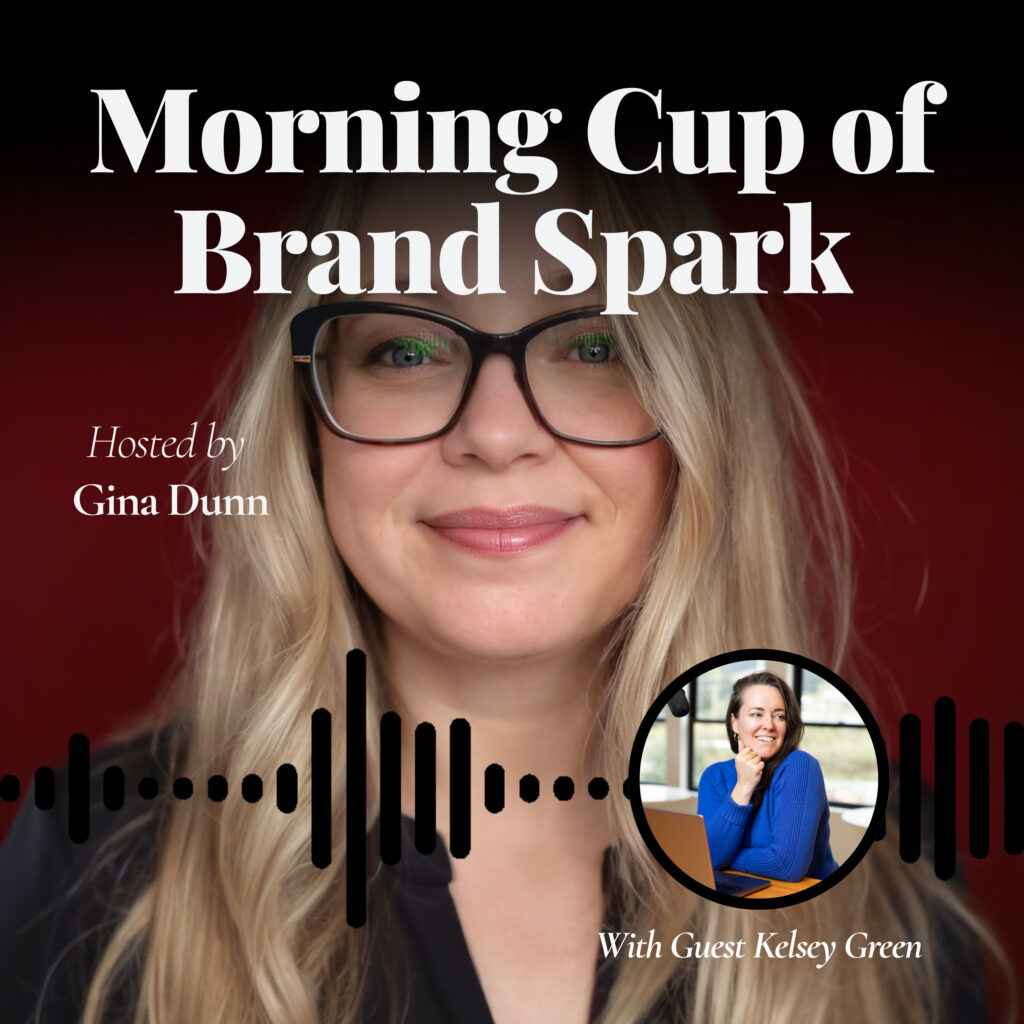
Ep 95 Rock Bottom, Digital Boundaries & Reclaiming Your Brain — A Mirror Conversation with Kelsey Green
Kelsey Green hit physical, mental, and emotional rock bottom. In this Mirror Conversation, she shares how digital boundaries, community, and tiny steps rebuilt her life.
What happens when your life becomes completely untenable (physically, mentally, emotionally) and you finally hit the wall you’ve been sprinting toward for years?
In this raw and generous Mirror Conversation, community strategist and facilitator Kelsey L. Green shares the story of her rock bottom: burnout, a toxic relationship, health crisis, anxiety, and the quiet realization that her life could not continue as it was.
Instead of collapsing inward, she rebuilt outward through therapy, coaching, community, physical healing, and one tiny step at a time.
In this conversation, Kelsey and Gina explore: The “busy coping mechanism” that masked deeper wounds How rock bottom becomes a clarity point Why digital overwhelm fractures our attention, our nervous system, and our ability to reflect The role of in-person community in healing The small digital boundaries that change everything How to start reclaiming your brain, your focus, and your life Why boundaries aren’t restrictions, they’re reconnections If you’ve been feeling overwhelmed, overconnected, or overstimulated… this episode is an invitation to breathe again.
🔗 Connect with Kelsey: Website: https://www.kelseylgreen.com Instagram: @kelseylgreen Summit in Six: https://www.kelseylgreen.com/summitin6 Screen-Free Sunday Challenge: https://www.kelseylgreen.com/screenfreesunday
"I was using being very very very busy as a coping mechanism—if you're high functioning you can pack your life really really full and not have to address core issues"
Full transcript
Welcome back to Morning Cup of Brand Spark. This is the Mirror Conversation Season. And this is a space where we talk about the moments that strip everything down to the truth. The moments that force us to stop performing and start choosing who we want to be. Today I'm joined by Kelsey Green, Community Strategist, Facilitator, and the creator of Summit in 6 and How to Build Your Circle.
Her work lives at the intersection of community, accountability, and taking back your life from digital overwhelm. But what I love most about Kelsey's story isn't the strategy part. It's the moment she hit complete physical, mental, and emotional rock bottom. And instead of hiding it, she rebuilt from that place with intention. Today we're talking about the mirror moment that changed everything.
and how digital boundaries, in-person community, and presence became her way back. So let's get started.
So Kelsey, thank you so, so much for joining me today on Morning Cup of Brand Spark. What's in your cup today?
I am so excited to be here. Thank you for having me. Right now I have water with electrolytes because I have already had my one cup of coffee for today, which is all I will allow myself these days. One cup of coffee.
One? How can you survive on one?
Yeah, it's tough, but I am a bit of a hyper individual and previously I I had no idea how much caffeine I was drinking but it was all throughout the day and I realized it was really not helping my anxiety. So now it's just one precious cup first thing
no.
now
I'm having like three cups before it's even eight o'clock in the morning normally. no. ⁓
Totally understood.
I love coffee so much. I would also drink it all day long if I could.
Okay, well maybe I'm gonna switch to some more electrolytes in my water. I'll try that too. So where are you joining from today?
I live in Washington state. I actually live in central Washington. So about an hour and a half east over a mountain pass from Seattle. And this area, if your listeners are familiar, it is so beautiful. There are so many mountains, rivers, lakes, and it's just, it's a lovely part of the United States.
I'm in the Netherlands and it's it's flat. I'm jealous. I'm super jealous of where you are. Awesome.
to the first
So let's jump into our mirror stuff today and our conversation around what happened with you. If we start with the before the mirror moment. So what did look like, what did life look like for you leading up to this moment that you called rock bottom?
Mm-hmm. Yeah. Well, I grew up in a family with a lot of drug and alcohol issues and was raised by a single mom. She did a great job. But that's a, you know, that's a tough role. And I did okay for myself in that I didn't get addicted to drugs. you know, yeah, yeah, right. Just sugar and caffeine. But and
Caffeine at the start, but... ⁓
alcohol, actually. But I was, you know, I put myself through undergrad and I was, you know, in okay health, I was traveling, etc. But I was definitely not addressing some of the core issues. One of my favorite coping mechanisms was being very, very, very, very busy. And if you are a, you know, high functioning person, and you like and I'm an extrovert, and I like being around people.
and I was using that to kind of buffer, well, you can really pack your life really, really, really full and not have to address some of those things. So I was, you know, I was doing a lot of interesting work. I was a wildlife biologist for a while and then I received my master's.
I can relate to that.
I went to Scotland, to Edinburgh University and received my masters there in geoscience. So essentially my masters and undergrad were both in environmental conservation. And from there, I continued to work in the wildlife field, but I ended up moving into communications and outreach and then ended up working in nonprofits. And, you know, there's a lot of amazing work that happens in the nonprofit sector.
And it's notoriously poorly paid. And so I was, as a single income household, I was struggling financially. was, oh my gosh, so, so burnt out. The good and bad news situation is that because I was making so little money in nonprofits, I had to have a side business to sustain myself. So I was running some events.
Mm.
I was producing different events and working for clients. So that was good. Didn't help with the burnout, right?
No, no, that only added to it, because at that stage. And how old were you then?
That was my mid thirties, I'd say. Yeah. Yeah.
⁓ cool. Crazy though. But that was your, that
was like, was that your rock bottom moment when you were, you had started your side gigs to be able to financially afford living and all of that.
Right. So basically, yeah, so I'm burnt out professionally. My health was not great. I needed to have I had uterine, uterine fibroids. I know a lot of women struggle with this. They were huge, huge, huge. So I was having a lot of pain didn't know what it was. So I had these huge fibroids, I needed a pretty complex surgery at that point. I was in a really toxic relationship with someone abusing substances and alcohol. I mean, a brilliant, a brilliant thinker, a professor.
no.
Turns out you can also be a drug addict at the same time. Right. And then it was COVID, you know, and that was about the time I started. Yeah. Deep trauma work. So it really, it really culminated in almost a comical amount of these, these various, you know, drivers that were sort of compounding each other. My anxiety was crazy through the roof.
⁓ Perfect storm.
No.
I was, you know, I was also struggling with some depression, but anxiety really over overrode that and I'd say I was just kind of a hot mess, right? And in terms of the moment, I, you know, I would, I am not sure I can think of a crystalline sort of moment, but at some point, you realize your life is completely untenable. Like, you know, I was just going to, I mean, essentially, it was like, you know, the moment when you say like, well, I'm
Yeah.
I'm not sure I'm long for this world, you know, at this pace. I'd say that's a pretty serious moment for contemplation. And I'm so grateful to have the privilege to have a therapist I've seen every single week for, you know, a long time now and a life coach, you know, I fully embrace and love coaching. have a trainer, et cetera. But anyway, I guess I can move into the next part of that. Yeah.
Totally. Agree, 100%, like 100%.
Yeah.
Everything, I mean...
You never have to go at it alone. There is never a reason to have to go at it alone. That's all of us, anyone. Anyone who's listening to the sound of our voices. there is, I've always been a huge proponent of coaching, of therapy, of continuous learning. We are never our perfect, no one is perfect. We're not our perfect selves. This is something that we have to continuously work at, continuously evolve. It's part of our lives. It's amazing.
absolutely agree and truly podcasts were life changing for me. So I did have the privilege to have those resources, but even if you don't, like you said, learning books, podcasts, and I started realizing, my God, there's so many amazing mentors out there and you don't have to be working one-on-one with them to learn all of these things, right? And I just, my gosh, I just got these like goosebumps because just thinking about the women that have been important in my life to help me.
cool.
Yeah, totally.
Mm.
move into, you know, truly a different paradigm. It's just, it's been incredible.
And I always say, we all have the ability to make ripples and help each other. And even if we think it's something super small, and it's not massive of something we can do to support or to help or to lift each other up or to promote each other, those ripples become massive for the women in our network. It's huge.
Yeah, and I will just echo your point. I don't know if I should put a trigger warning around this, but one of the most impactful moments in my life was when I heard a woman on a podcast talk about her sexual assault. And the first thing I thought was, oh my god, I can't believe she just said that out loud, like on a recorded podcast. But then it started giving me the courage to show up for my own life and address some of the things that have happened for me.
really?
And I realized just her saying that she didn't go into detail, but just her, know, talking about it from the point of a survivor and having come into a different place in her life. It was, it was like, once I got past that, like, my God, you know, I realized like, women are starting to talk about this and share and bring each other in into a space where it's okay to, to talk about these things, you know, and that really gave me courage.
Yeah.
Yeah,
that's it. Couldn't agree more. It's awesome. Awesome to hear and awesome that you had that experience too.
So with you in this moment that you were in where you realized you had hit rock bottom in some way, what were you... I know it was a bit physical at that point, it was mental, it was emotional and the rock bottom was there. What did you do to come out of that? What were your next steps and how did you realize that you couldn't keep living that way? What did you do?
Yeah.
Yeah, well, the realization was was very obvious and and the steps were, you know, I would just say for anyone listening, if it's messy, that's fine. You know, this might be really painful and really messy. And one of the truths that I had heard, thankfully, before I went into this little abyss was that it may get worse before it gets better. And that was
Love that saying,
so true.
Yeah,
that was 1000 % true for me. The other piece just in terms of female relationships is I had heard a lot of entrepreneurs, business people, and just people on a personal growth journey say that when you start to enter into this space, people are going to start falling away. And it can, it can feel quite lonely. And I thought that was probably true for them, but I did not think it's gonna be true for me. And in fact, that was exactly what happened.
Women I had been friends with for decades, you know, just did start to kind of fall away. I wasn't, I wasn't like going out to the clubs anymore. I wasn't really drinking a ton, you know, stuff like that. And just once you step into a business space, sometimes you do kind of lose those people. And that was really tough. But back to your question, the steps were messy and teeny tiny, you know, to the extent that they almost felt.
What?
Yeah, okay. Yeah.
like not non steps, right? And, you know, it's like, and then of course, there's the couple steps back, and then, you know, more steps forward, one step back, five steps forward, you know, it's not linear. And for people that are going through this process, I always tell them that because there can be a lot of shame, a lot of just, you know, strife and pain around personal growth. And I always remind people
This is not linear, you know, but the littlest things you can do each day are going to help. So for me, was truthfully letting go of drinking. It was finding new mentors, new people in my life. It was, like I mentioned, therapy. was life coaching. I created the strongest circle of women around myself that I could. So I, yeah, I hired a
Hell yeah.
you know, a trainer, a personal trainer, I hired a nutritionist, not all at once, you know, I didn't have the funding to do all of this. But, you know, I've picked a couple key mentors and I followed their work, you know, their podcasts for hundreds of episodes, you know, and I just put the time in and that meant, you know, you don't have time for everything. So that meant having to let go of things like hanging out people I didn't really care about. And then I
to transition us maybe a little bit into a topic I think we're discussing today is that also meant letting go of some things like doom scrolling, tracking the news nonstop, as much Netflix, things like that, putting some boundaries in place so that I could be in my own brain, process those emotions, think through these things, create that space to build the business, connect with new people in my life.
do the internal personal work.
And do you think that that digital, let's call it overwhelm in some way, did that also play a part in how you felt at that moment before you got out of it? Did that also play a part there?
I believe so. Yes. Yeah. And this, you know, this isn't, I'd say, it wasn't necessarily a strong correlation in my life. So I wouldn't suggest that of all the things I was dealing with, I don't think social media was, was really, you know, one of the main drivers or anything. But it's more so that I wasn't creating the space in my literally in my own brain to work through some of these things. So I was using
Zinc closet,
streaming, scrolling, etc. as a coping mechanism, you know, to avoid having to do some of that work.
Hmm.
yeah. And now, now that you've had the experience, you have overcome, you have put these protections in place also around digital boundaries, what does your life look like now? What does it feel like now?
Yeah. Well, one of the issues and you know, I will just preface this part by saying there are some incredible, so fun, so cool things, you know, about our digital world these days. I don't think anyone's arguing that it has not benefited us in some way. When I had to have this complex surgery, it was done laparoscopically, you know, that's because of technology. That's incredible, right? You and I are connecting in this digital space. You're in a different country.
Isn't it cool?
This is amazing!
So
cool. There are apps I'm like delighted to use. I love it, right? So I am not suggesting that we don't embrace the really cool positive things about technology and being in the digital space. What I'm saying is that when you completely release your autonomy or any control over your digital use, especially with apps that we know are designed to be very addictive,
Right? Modeling the mechanism of slot machines, you know, and our brains are becoming wired to need this all the time as a compulsion, it does become more difficult to bring some of that deep work into the world. Right? If you're trying to finish a book, if you're trying to launch your business, if you're trying to do some of that deep personal work, you know, it...
becomes a little more difficult because our attention is more fractured. We have kind of messed with the dopamine mechanism in our brain. And so something that used to be like marginally boring, like going for a walk or whatever now is like, you're crawling out of your skin. It's so boring, right?
It's
so painful. But then when you go for your walk, you have your earbuds in and you've got your phone, you're playing Pokemon, you're doing whatever. So you still have all of these things potentially still and then you're walking into a pole. Yes, that happens too.
Yeah, yeah. So for me, I worked on putting some parameters in place and I will say I'm still on the journey. I can get down with everyone else with a with a super sweet Netflix binge. Like, you know, I can doom scroll with the best of them. But what I'm working on is putting some boundaries in place. For example, I work on being off
Mm-hmm.
screens from 7pm onwards and I go to bed pretty early so you know let's say by 8 30 I'm in bed or I'm with people and and I my gosh I do a lot of ⁓ it's annoying yeah yeah but one of the things I care a lot about is building in-person community and holy moly it has been pretty tough you know to see relationships really start to disintegrate
How do you do that? Because they're on their phones.
Yeah.
because people are prioritizing their phones over being in, you know, in person. So really... ⁓
Over.
And you see that with families too. You see that
at the dinner table, you see that with family. I'm fighting with my 12 year old to get him to take his iPad off the dinner table while we're all eating dinner. So it is infiltrated all of our lives, especially in the next generations.
yeah, I do not envy parents right now. And I will note a resource for parents, the book, The Anxious Generation, also an audio book by Jonathan Haidt, incredible data driven book. It's amazing. Also, probably pretty scary for parents. But check it out. yeah, so we see these things happening. Again, noting the incredible benefits of technology, we have seen a direct correlation
to the rise of the smartphone, to decreased mental health, especially for youth, but also for adults. Lulliness, isolation, all of these things increasing. again, what I'm working on is putting these boundaries in place and having my phone. This is a critical point. It's so simple. But a critical point is having my phone out of my sight, not with sounds on, so silenced.
when I'm trying to do my deep work, when I'm doing client work, right? When I need to process something in my own brain. And there's a study that shows that when your phone is next to you, even if it's face down, or someone else's phone is face down, your attention is literally more fractured.
Hmm.
I feel like you're talking to me as I looked over
my phone. It's like right here.
Yeah, your attention is literally more fractured. And so there's a lot of people, but especially adult women who have been diagnosed later in life with ADHD. And I'm not suggesting that that's not real. But for myself, I could not focus. I could not get a project done. I couldn't sit for 15 minutes without feeling like I was crawling out of my skin if I wasn't, if I didn't have my
like anxiety
because you didn't have it in your hand or because you weren't looking at it.
Well, I didn't realize what it was at first, right? And so then I started researching this, understanding it more and practicing it in my own life. And the more space I can create from my phone, I'm telling you, the calmer I feel, the better I feel, the more I can focus, the more I can get done. Because my goal is not to work a gajillionty millionty hours. My goal is to work hard.
Yeah.
Mmm.
Yeah.
you know, get things done and then experience all the other wonderful things there are to experience in the world, is, you know, creativity, art, know, health, physical wellness, relationships, right? Being outdoors, like all these things, a of them do not include phones. Yeah.
Yeah, indeed.
And other people around you. It's different environment. Yeah. Okay.
So
yeah, so I guess my point is just that, you know, I'm working on these experiments on my own brain and I feel like there is tremendous benefit to setting some parameters around your use, even similar to the conversation we just had about personal growth, even if they are little teeny baby steps, you know, for you, whatever that means. For me, it's trying to have my phone off for 24 hours at a time. You know, it's leading back. Yes, yeah.
Mm.
is that where your challenge is coming from? The Sunday challenge?
I saw that you're doing a challenge. ⁓ Do you do this twice a month or so, right?
Yeah.
Yeah, once or twice a month and I will tell you 24 hours off screens is turning out to be pretty impossible for most people, you know.
I don't think
I could. I really honestly don't think I could. I go to sleep with my, there have been nights I've fallen asleep with my phone, like, in my hand. Like, actually, in bed. I just cannot imagine.
Yeah.
And how is your sleep?
Really good, I like a 99 sleep score every night. So I still, but I do force myself to like at some point turn it off. But it's definitely the first thing I do when I get up in the morning because it's my alarm and it's the first thing I do. This is the last thing I do at night when I set my alarm. So there is still, I'm very inspired by this though. I would love to try some sort of detox. I feel like I have to detox myself. It's like caffeine. How do you stop? I just couldn't imagine.
Amazing. That's amazing. Yeah.
Yeah. Yeah.
Yeah.
Totally.
Yeah, I mean, you seem like, you know, you are very positive, upbeat, you know, like lovely person. So I'm not saying this is like for everyone. If you feel like, you know, good about your use and it's not affecting your sleep, like you've got a good sleep score, you're getting enough sleep, you know, it's not like every single person needs to do this. Yeah, it's. Yeah.
It's not for everyone, no, okay. But I do believe you and I do totally agree
that there is a benefit to embrace the world around you and the people around you that, quite honestly, when the phone is in your hand, you're ignoring them, the family as well. There is definitely an impact there.
Yeah, right. Yeah, absolutely.
Yeah, and also I think it's interesting just to run some experiments on your own life, on your own brain, you know, and see like for the 24 hour screen free Sunday challenge. my gosh. If you aren't sure if you have a problem with your phone, try to do the challenge and you will know. You will know because the first time I did it, yeah, the first time I did it, I was pacing around my house, like looking for something.
That's cool.
Quickly.
I didn't even know what it was. I felt like I had, like I was, I was missing a meeting or something, you know, this like weird, yeah, weird underlying just like, kind of, you know, anxiety. And then I realized, my God, I'm so used to just reaching for the phone. And that's the key here is, you know, it's that there's, there's so much less space to just sit for a moment and
You were, with your phone.
⁓ Wow.
contemplate and be still because we're so used to reaching for the phone. The second we even feel the tiniest hint of boredom, right?
Yeah.
but that's also the difference in kids these days. Really, very, they don't know. I had a conversation once with somebody who, we also, like I was, I didn't come from mobile phones. I didn't have mobile phones when I was a kid. So I was in the woods playing with sticks. I was in the middle of the forest playing with things that these days, don't, no kids know what that's like.
Mm-hmm.
I know it's actually it really makes me sad. It's heartbreaking. And I'm in my early 40s. So I also grew up, you know, up until college, I didn't have a cell phone. And even then it was like a really, you know, wasn't a smartphone. Yeah. And I it's it's a different universe now. And I feel for parents and I feel for kids and and and the data is supporting this right. This isn't like
It's same, same.
anecdotal, it seems like kids are doing worse, but the data really does show that it's they are they're struggling, especially, especially girls, it breaks my heart.
but it's true.
yeah? Is it more with the females? That's what the data shows. ⁓
In terms of, yeah, confidence, mental health,
struggles, suicide, yeah.
Do you have any advice for anyone who they want to actually, I don't know, if someone's glued to their phone, if they're me and they're glued to the phone, and they're asking, hey, what can I do to actually take a miniature experiment? What kind of miniature experiment can I do if I'm overwhelmed by digital life?
Yeah.
Yeah, thank you. This is a great question. you know, the place to start, think is, it's just kind of pondering the issue, you know, with anything like, like thinking about, like I said, you know, you know, it, where is my USAT, right? Like, you might feel good about it. Or if you, I'd say almost always, even if you have, you know, you're, you're okay with where you're at, people usually have a sense that
they do have a bit of compulsion around their phone, right? And it just become a little bit more challenging when you do it for your business. And you do need to be responsive to clients or, you know, just whatever it is, of course, you know, or any of kids, you know, if you have or an aging parent, and you need to have your phone sounds all the time, it's it's tougher, right? But that is definitely not 24 hours a day. So questioning, you know, is there some small teeny tiny ways
Of of course.
Yeah.
that you can just put up a little bit more of a barrier. So could you set just five minutes earlier that you get off your phone at night, put it away and see how that feels? Could you try a two hour chunk where your phone's literally like in the closet? know, could you, it's kind of wild. If you're not eating dinner with people, a lot of times people are just eating in front of the TV or both, they're with their families and eating in front of the TV.
Yeah, Yep.
What does it
feel like to return to just eating a meal without a screen? Right? Yeah. Yeah.
devices, within any device,
and just talk.
Yeah. And I will say just as a quick aside, know, there's a lot of worry about kids right now. It's super valid. And oftentimes parents don't have a good use on, you know, a good handle on their own digital use, right, as well. So it's sort of, um, modeling that, that behavior. Yeah. Yeah. Yeah.
We teach it too.
Yeah, totally. And what do you, do you have any advice for someone who is afraid to unplug because their work is tied to being online? You already, you touched on it already, but what if you do want to unplug a bit, but yeah, the clients, what do you do if your work is online?
Yep. Well, I would say this might be more of a long game, truthfully. If you have set up a system where you are expected to respond immediately at all hours of the day. I mean, I would not say that's a sustainable business. Maybe that's just for a short amount of time. You know, sometimes we're in hustle mode. Sometimes we just have an emergency. Like there were some wildfires here. I had a client that was managing literal infrastructure, you know,
potentially catastrophic failure, that's obviously different, right? Yeah, so that's an emergency. you know, I guess it's sort of just like, you know, thinking about can you start to put in place a couple boundaries with both you and your clients or whatever it is? I talked to a woman that was a digital marketer, so she's in the space, and she talked about, and I...
⁓ That's something different, yeah.
yeah.
I hesitate to even use this term because it felt so crazy to me at first. The term is strategic negligence. Can't f- You know, as a service provider, makes me like, whoo, shudder a little bit.
Okay?
Okay, now I'm curious.
That word
isn't there!
But can you, even if you're available at 8 p.m. at night when you're with your family, can you just punt it to the next morning and start to maybe just ignore some of these things that come in outside of the boundaries and then gently suggest that you're moving into a different, whatever it is, whatever you wanna say that is that you have the working hours that you respond during these times, et cetera.
These days, I write into my contract that I practice a deep work philosophy. And especially for the clients that I'm billing in every 15 minute increments, they've actually been pretty responsive to me saying, when I'm working on for you, I am fully focused on you, which means that when I'm working for other clients, I do not answer calls, I do not answer texts, I do not answer emails. And they actually appreciate that.
Hmm.
Mm-hmm. Mm-hmm.
I think that's an awesome
boundary though. I think that's really cool because they know that they get their full attention when it's their moment to get full attention. And if they're contacting you outside of that full attention mode, then they're in line basically to get your attention. I think that's brilliant to work in. I like that.
Right. Thanks. Yeah.
I wouldn't say it works for every client and I wouldn't say it works all the time, but the more you can put it in place, you know, just that, that old adage, like you teach people how to treat you. You teach your clients how to treat you. If you didn't start out this way, is a little tougher to move into this mode, but you know, it's, I think it's critical for your life. And when we talk about burnout, which is a real issue with women that are, yeah, running and you know, women and men.
That's everywhere.
running their own businesses, working, you know, in corporate sector, nonprofit sector, all, you know, all these different jobs. It's, it is critical to set this up if you want to be doing this, you know, into the future.
Yeah, at some point it will become too much anyway. Yep, you will hit the wall anyway.
Well, I wanna thank you so much for joining me today. You've definitely inspired me to try one tiny little thing. I'm gonna do something, I don't know what yet, might call you later, but I wanna try something, something, because I am definitely fully plugged in 24-7. I'm one of many that are like that, I'm sure. I'm not the only one. My child is, my whole family is, like we all are. If my dog could have a phone, he would have a phone too. But I'm gonna try something. I will commit to trying something.
But before we head out, where can people find you? Where can they connect with you? Talk a little bit about your mastermind. It would be awesome to let everyone know where they can find you.
Excellent. Thank you. Yep. So my website is Kelsey L Green, L like lemur green without an E. So Kelsey L green.com. Instagram is the same handle. You can find me on LinkedIn and I run a screen free Sunday challenge. Like we said, one or two a month. And I am also coming up with a program that is a more of a baby step introduction program because yeah.
Is that for me?
24 hours is turning out to be...
Can I have like an hour? I'll join you on that one.
Yeah. Wow. Yeah.
Yes. This is good feedback. Thank you. Yes, exactly. So I'll be launching that in the new year, a little baby step program. And then yes, the mastermind is called Summit in Six. This is a six month container, high accountability, high touch mastermind for women, creatives and entrepreneurs that are trying to bring anything out into the world that's been on your heart, especially projects that take a lot of focus. So writing your book,
launching a business, becoming visible in the speaking space, creating a gallery exhibit body of work, whatever it is, we do that together over six months. And one of the pillars is called focus. And that is code word for setting up some of these boundaries so that you can really have space and time to do that work.
Cool.
And do you work with people, because my audience is all over the world, is it virtual? And can people all over the world join? How does that work with your mastermind?
Yeah.
Absolutely. Yep. We use the digital tool as a tool and you know, in this case, so yeah, this is a digital mastermind. A meeting live. Yeah.
Cool, so anyone all over the world, so then you have time zones that match somehow for anyone. Awesome. Well, I thank you so, so much for joining.
Yeah.
It's been so fun to connect today. Thank you. I'm grateful for the digital space. Yeah, at this moment for sure.
and then we'll do it again. Awesome,
thank you.
Thank you, Gina.
Well, that was Morning Cup of Brand Spark with Kelsey Green. A reminder that rock bottom isn't a failure point, it's a clarity point. Her story shows us that boundaries aren't restrictions, they're reconnections. To presence, to community, and to the version of ourselves we've been too busy to meet. If this conversation shifted something in you, share it with someone who might be carrying too much right now. So until next time.
Keep your coffee warm and your mirror super close. See you next time.
Key takeaways & FAQ
Five things to steal
- 01 Setting digital boundaries isn't restriction—it's reconnection to presence and deeper work
- 02 Fractured attention from nearby phones reduces focus even when devices are face-down
- 03 Strategic negligence teaches clients to respect your deep work hours and boundaries
- 04 Personal growth rarely follows a linear path—expect messy steps forward and back
- 05 Building an intentional circle of mentors and coaches accelerates transformation during rock bottom
Frequently asked
Start with tiny baby steps—try a two-hour phone-free chunk, eat one meal without screens, or set your phone away five minutes earlier each night. Write a deep work philosophy into your contracts stating you fully focus on one client at a time and don't answer calls or emails during dedicated work blocks. Strategic negligence means gently training clients to respect your boundaries by occasionally punting evening requests to the next morning. The key is creating barriers gradually rather than expecting overnight transformation.
Notice if you reach for your phone the instant you feel even slight boredom, or if you pace around feeling anxious without it nearby. Research shows phones within sight—even face-down—literally fracture your attention and focus. Many people who couldn't concentrate for 15 minutes without feeling like they were crawling out of their skin discovered their ADHD-like symptoms improved dramatically after creating space from their devices. Try a 24-hour screen-free challenge to quickly identify if you have a compulsion problem.
Accept that personal growth often means people will fall away—friendships that lasted decades may end when you stop prioritizing clubs, drinking, or constant social availability. Focus on building an intentional circle by hiring mentors like therapists, coaches, trainers, or nutritionists, and follow podcast mentors for hundreds of episodes. Let go of time spent with people you don't truly care about to create space for processing emotions, internal work, and building your business. Progress will be messy, non-linear, and may get worse before it gets better.
Data-driven research in books like The Anxious Generation by Jonathan Haidt shows a direct correlation between the rise of smartphones and decreased mental health, especially for youth and particularly girls. Mental health struggles, loneliness, isolation, decreased confidence, and even suicide rates have all increased alongside smartphone adoption. Kids growing up with constant digital access don't experience the boredom, stillness, or unstructured outdoor play that previous generations had, fundamentally changing how their brains develop and process the world around them.
Liked this episode? Get my weekly semi-regular newsletter on brand and positioning.
One short read every few weeks. Just the sharpest thinking from the period, from me to you, in under five minutes.