
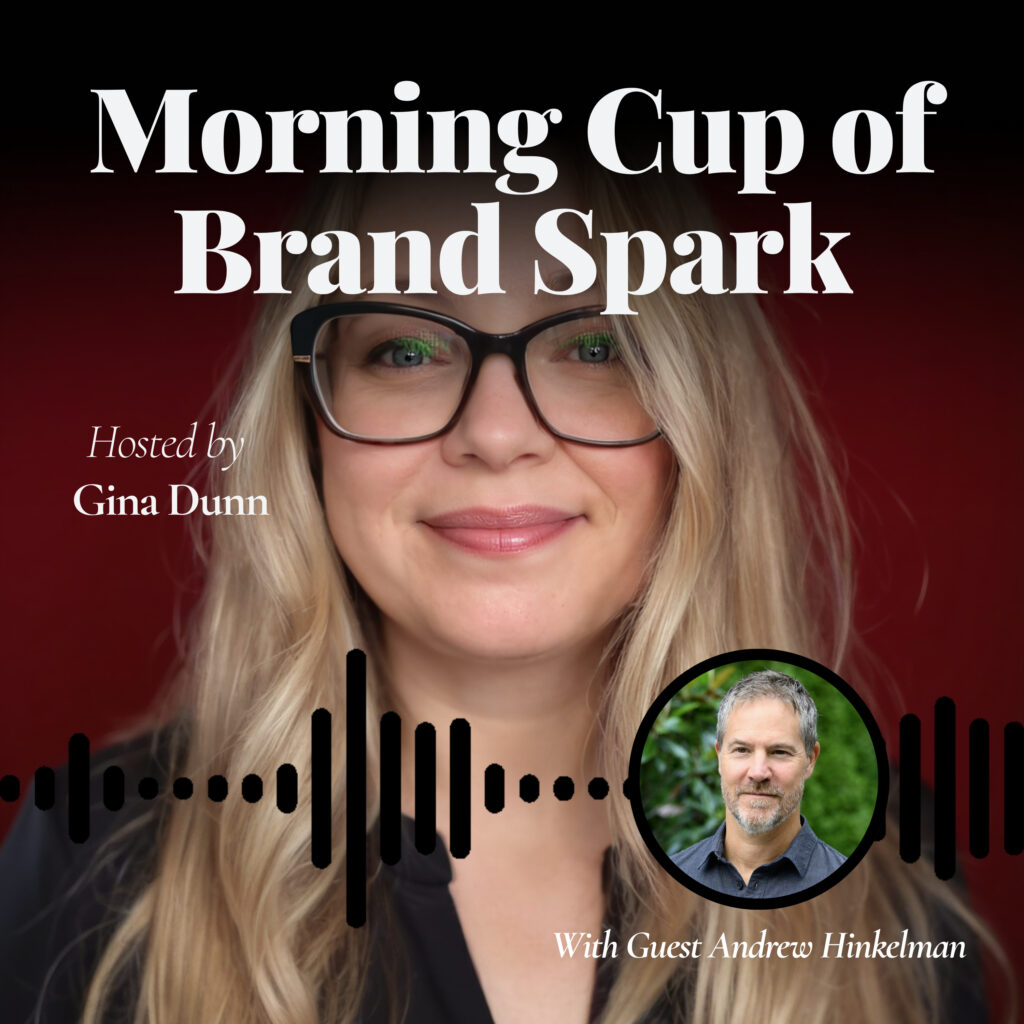
Ep 101 — The Invisible Ceiling — Andrew Hinkelman on Burnout, Boundaries & Human‑Centered Leadership
In this Mirror Conversation, Gina Dunn speaks with former CTO turned executive coach Andrew Hinkelman about burnout, boundaries, and the hidden emotional costs of being the smartest person in the room. This episode explores what happens when high performers stop fixing everything and start leading like humans.
Burnout doesn’t usually arrive as a breakdown. It shows up quietly — as exhaustion, apathy, and the slow erosion of self‑awareness.
In this episode of Morning Cup of Brand Spark, Gina Dunn sits down with Andrew Hinkelman — former CTO/COO and now executive coach — to explore the invisible ceiling many technically brilliant leaders hit.
Andrew shares how years of overwork, identity attachment, and self‑neglect culminated in physical burnout, forcing him to confront the limits of strategy, intelligence, and hustle. Together, Gina and Andrew unpack why leadership is ultimately human work — and why boundaries, vulnerability, and self‑understanding are not optional extras, but foundational skills.
This conversation is for leaders who look successful on paper but feel depleted behind the scenes — and for anyone ready to lead without losing themselves.
Andrew offers complimentary discovery coaching sessions for leaders curious about executive coaching.
👉 Learn more or connect with Andrew on LinkedIn: https://www.linkedin.com/in/andrewhinkelman/
"Effective, strong leaders are happy people. So what do you need to do day in, day out to put yourself at the best chance of having a strong, positive, optimistic kind of day?"
Full transcript
Welcome back to Morning Cup of Brand Spark, the podcast where we slow things down and explore the moments that change how we see ourselves. These aren't conversations about success, visibility, or getting things right. They're about the mirror moments. Sometimes they're the reckonings, the collapses, and oftentimes they're quiet decisions that shape who we become next. Now today's conversation is about burnout, self-awareness,
and the emotional rewiring that's required to move from being a high-performance manager to becoming a true leader. You'll hear from Andrew Hinkelman, a former CTO and COO turned executive coach, on what it looks like to stop fixing systems and start understanding himself and lead humans with more trust, range, and courage. Let's get started.
Hello, Andrew. I am awesome. Thank you so much for joining me today on Morning Cup of Brand Spark.
Hi Gina, how are you?
Thanks for having me, appreciate it.
I'll kick us off with one of my rituals that I do. I know it's evening for me, but it's not evening for you, so what's in your cup today?
You know what? I'm having yerbe mate So I'm already through the coffee phase of my morning since it's 10 a.m. here Pacific time.
Really?
I be on my fifth cup by then.
I have a problem. Yerba Mate is awesome. I don't know a lot of people that drink it. That's so cool.
I transitioned. Yup. I love it.
Yeah, I took two a few years ago and you know, I've been a heavy caffeine abuser for a long time, so I can still, it still provides that. So it's nice.
you
Yeah, but it's light, right? I have two of the cups downstairs. One of my colleagues back in the day had introduced me to it. I was like, what is that? It just looked so cool. The routine with it,
Right, right, right. Yeah, I don't
have the Gord system going. I'm still in the sort of the French press phase. So it's a little like a
you don't?
⁓ I didn't even
totally didn't know you could do it like that. See, I'm learning something from you in the first five minutes. Well, this podcast is all about the stories of the moments where we, where we, you know, we drop our mask in some way or we see ourselves again, clearly. I call those mirror moments, right? And as leaders and founders, I, everyone that I've spoken to has had something that's happened to them.
Yeah, yeah.
in their lives where they have, there's been this transition in some way and they've had a mirror moment and it's fascinating to me. but, and I know you have had one too. but if you can take me back to the time, like before that mirror moment happened, you spent years leading engineering teams, right? So when did you first feel that something was off or maybe something wasn't working anymore for you?
Correct.
You know, I had an experience that I think now is actually pretty common for a lot of people, which is about 10 years into my career. The promotion stopped the, you know, the increases in salary stopped the cool projects that everyone wanted. You know, they, sort of dried up for me and I, I had really no idea what was going on.
because I was always tuned for getting more technical, getting the next certification, all that. And I really had to look in the mirror. And I did the DIY version of self-help a bit there. And that was really helpful. I started to of realize, maybe I'm not as great as I think I am.
Mmm.
off
Mm-hmm.
you had a self-doubt kind of creep in as well.
Yeah, so, you know, I realized, you know, I was walking around the office, you know, at the time I was at Microsoft. I realized I was kind of a jerk, you know, and I avoided a lot of people and, you know, kind of acted like they were lucky to have me.
And doing what you had to do as part of that role then, I guess.
Yeah. And so, you know, it really drew me towards more of a sort of people orientation and just getting to know people and not in a transactional kind of way. think, especially in the workplace, people communicate a lot, but it's always transactional or most of the time it's transactional. And I think that's a little bit of a missed opportunity.
Mm-hmm.
Mm-hmm.
Right.
Yeah, having real relationships. And back the moment that you feel you had a sort of burnout?
Absolutely.
You know, that was a little earlier. And that that sort of moment of, you know, self reflection and some really, you know, some deep work then really pushed me into a lot of my the success of my career. So that was a little bit of a catalyst moment. I picked up things like meditation, which I which I I
It was earlier.
Mm-hmm.
Mmm.
credit for really driving a lot of my career, but I got really off track when I was a chief technology officer and, you know, did all the things, working, you know, 18 hour days, all those things that really drove me towards burnout. So that was a little later.
And did that change going through that burnout phase? Did it sort of change how you saw yourself do?
Yeah, I really kind of thought I can handle anything. I don't need to focus too much on my health. You know, I'm invincible. I'm, you know, I'm different. Right. Like, there's other people that need to make sure they get enough rest. There's other people, you know, I'm me. Have you met
Mm-hmm.
You're like, I'm not one of those. Yeah, of course.
And I know it sounds
Of course.
It sounds like a lot of a lot of ego and and it probably was but I loved the role. I loved the company I was at but I gave myself away fully to lost myself fully consumed but in a a not in a not in a serve necessarily in a survival kind of way. I mean I was legitimately passionate about it. It's just that it
Yeah, you're consumed with it, right?
Yeah, you loved it.
It overtook everything.
And then at what moment did you decide to change that?
Well, the interesting thing about burnout, and I talk about this a lot with my clients, because a lot of the people I work with are in the range of burnout. And so it's really sort of a spectrum. And I didn't know I was in that. I had no...
Yeah.
context, I had no idea. I didn't know what was going on, but I would come into Monday exhausted. Yeah, a week, a week of vacation would do absolutely nothing. You know, I'd come back and by Tuesday, Wednesday was like I never I was never out of the office.
I'm really still.
And did you ever really disconnect on that week you're off? I hear that so many times from people. Well, I must admit I do it too. I don't disconnect.
Yeah, yeah.
I think it's different if you want to be connected versus you feel compelled to. I think it's a little bit different. Like for you, you probably like to keep things on track and kind of check in and stuff like that. A lot of people feel compelled to, they feel like they can't leave their laptop at home. But yeah, it's a little bit different. you know,
Totally.
Yeah, then it's a different.
I guess my point is if you're really in some phase of burnout, a week off is not going to do it. It's not going to change anything.
And what was the moment that you really did make that change?
Well, you know, I kept going deeper and deeper into it. And then at some point, like apathy kind of comes in and you start to care a lot less about things. And I woke up and got out of bed one day and my back was completely thrown out. And I think it was my body's way of saying, Hey, hang on, you know, wake up exactly. And I, um,
Bye.
Wake up. Yeah.
You know, went to all the doctors and tried to figure it out and was getting worse and worse and was having trouble locking and in physical therapy for quite a while and was almost going to get surgery and started to get a little bit better. But it was really, it was really the wake up call. You know, like I couldn't go into the office because I couldn't sit in my car and I couldn't drive.
Wow.
Gosh is that what led you to yeah also to change how you're helping other people to
Yeah.
Totally, totally. So now when I work with people, it's the human being first. And I think that a lot more people need help being heard and being listened to and helping them feel like it's OK to focus on yourself.
That's critical even.
critical, it's necessary. If you think about it logically, if you work for a company, the CEO or whoever's running the company, the people at the top, they don't want a bunch of sick people working for them.
Yeah.
No, no,
no, I wouldn't think that's something on their list.
No,
it's not in the job description.
No, at least not the one we read. And you work with lot of CTOs and CEOs now, right, or founders who've sort of hit this invisible ceiling that you talk about. What about the ones who break through that ceiling? What do they do differently?
Nope.
Right.
Well, it won't surprise you that part of it is figuring out the boundaries and the balance between when to kind of pull back and take care of themselves. what I like to say to people is effective, strong leaders are happy people. So what do you need to do day in, day out to
Yeah.
Mm-hmm.
Put yourself at the best, to give yourself the best chance of having a strong, positive, optimistic kind of day. And honor that, right? It takes self-discipline.
Mm.
Yeah, and you show
up as a different person for the people around you and for your team as well when you're like that.
Fully, yeah, yeah. you need to be able to manage people and have your staff really, really engage with you and trust you. You need to be able to be present and be healthy and be optimistic.
Yeah.
And what do you think about vulnerability in that mix too? Because I hear about that a lot as well, that leaders aren't vulnerable enough sometimes.
Well, the version of vulnerability that I can make very, very practical for people is that you need to open up a little bit so people can get to know you. So if you have someone that works for you, Gina, and you're having a one-on-one and you're talking to them, you might ask them a lot of great questions about where they want to go with their career or what they did on the weekend or whatever it is.
Mm-hmm.
Yeah.
Yeah.
But if you're not talking about yourself a little bit and opening up, like, you know what, I tried this and totally failed because, you know, there's a lot of people don't want to talk about themselves and open it up. And that's, think, the vulnerability that builds trust.
Yeah.
Yeah, you're right. And it makes it human too. And the more you listen to other people and be part of that conversation, but definitely the human side of the connection with your team is so critical.
Yeah, that's what people connect with, right? It's not a spreadsheet or another sort of flow chart that people are going to connect with. It's humans.
Yeah, it's a long time since I've been in a corporate, but I think, I mean, I would hope that that's changing a little bit, right? That there is more acceptance of the human element and the vulnerability element. I don't know how it is now though. It's been a while.
I would say there's a lot of positive change, but a lot of that is in the newer companies. There's a lot of legacy kind of hangover from the past. Yeah.
Yeah, that
carryover makes it hard to change. Cultural is so difficult to change. Internal. Especially talking about some of those big ones.
Totally.
Culture is incredibly
hard to change, especially because the people at the very top have to be bought in and usually they're the ones that keep the culture.
That's true. if you had to name what this new version of yourself is now after you've been through the journey that you've been through and how you're helping people now, what would you call it now?
That's a really good question. I guess I'll use a phrase that I use in certain circles, and it's just human centered. I like that phrase a lot because it gives other people permission to care about themselves and care about the people that are around them.
Mm, okay.
So it's not just human centered as one, it's both. It's yourself and those around you. So the care and the importance of all of the humans.
Yeah, and it's something, it's a message you're not going to get when you just like kind of walk in the door to work or whatever. It's really, it's giving permission to that. Look, like I'm a, you know, I'm ⁓ a male adult who was in technology, right? Like, I'm okay with like waving the flag around, let's be more human. I want people to feel like we
you
Thank
Yeah, right.
you know, everyone has permission to be a little bit more real as they, as they relate to other people.
Awesome.
And I say, especially now with so much noise in the world and so much AI and just so much, yeah, everything is, can you trust it? Is it real? The human element, we're losing a lot of it right now. So I'm embracing this too. I'm also waving the flag all over that. I'm with you.
Right.
Yeah, yeah. Well, it's
funny because especially you look at a place like LinkedIn and now people are purposely putting in spelling mistakes in their posts so that so people know it's not AI. It's hilarious.
Yep.
I know it's crazy. I
do another podcast all about AI and it's a topic that we talk about a lot. And I wrote on LinkedIn about today as well. It's crazy how much it's an infinite circle with the, I could talk about it for hours. We've trained the bots, we keep training them, now we're training them that spelling mistakes are correct to make. It's insane.
Right.
Just no more dashes, right? Yeah.
Ask an author about dashes and then you'll hear them freak out on you. Right? ⁓ really? Sad, right? It's not the devil, right? dashes are not bad, but now we're not allowed to use them anymore.
I know. I know. I was an English major. I know all about. Yeah, I'm a reformed English major.
I know, I love them. I'm nostalgic for them.
so if someone is listening right now and they feel stuck in their leadership right now, no matter what role they're in, but they're in C level somewhere, what's the first honest or practical step or a question you would actually invite them to try?
Well, I like to make this really, really, really simple and that is how much time are you allowing for yourself? And so if you have the highest level of energy in the mornings, then block your mornings for your own strategic work. Because one of the things that most people, where most people get stuck is they start to care too much about things they don't control.
And that can lead to a lot of frustration. you know, control your time, protect your time, honor those boundaries. And by the way, if you're in a senior role, you should be producing strategic work and you can't do that in between emails and in between meetings. So,
Yeah.
Haven't
we all have we all not learned that by now, but it's a tough one to still do. It's tough.
It sure is.
It absolutely is, especially with the phones and the notifications and all that kind of stuff. But that, but if you're doing, if you're a senior in any role, doing your job means producing strategic work, whether it's planning, roadmaps, whatever. So you're going to need to block your time. You're going to need to shut the world out and you need to get good at that.
Yeah, those boundaries, they're tough. I've been doing what I do for more than 25 years and I think I will always have that love-hate relationship with boundaries. It was even on my, what do need to get better at this year focus? Boundaries, boundaries, more.
Right, yeah.
And we hear the actual word boundaries so much that it almost doesn't have any meaning, you know? It just rolls right off of us.
devalues a bit.
Yeah, another one of those things that we are supposed to do but we don't all know how.
Right. Yeah.
And that's why I like to emphasize, hey, do your job. Be more strategic. And part of that, too, is knowing what you want, personally. I talk to a lot of very senior people, and I'll ask them what their goals are, and they'll just give me a rundown of their company goals for the year. And it's like, no, I mean you. Yeah, you.
Yeah.
Which wasn't what you asked.
You, what
do you want? Where's your career going? So, you know, that's another piece of it.
Yeah, really good one. That's something that we should all never forget to think about as well.
Yeah, for sure.
Yeah. And you really triggered something for me earlier. I actually wrote it down in front of you when we were talking about, yes, sometimes it's important that you take your time away and you take your time off and you have a clear separation, but other times that actually it's okay that you are thinking about it and worrying about it and doing it other times as well. It's about different people have different needs and it doesn't necessarily mean that it's a horrible thing either. Yeah.
Mm hmm. Yeah. And give yourself permission. Like, hey, if it's a want and a desire, you know, no harm.
⁓
Yeah, you're right. I think that really stuck with me. So I'm going to keep that in mind for myself too, because I tend to not shut off at all. you tend to, if you like that, you tend to also sometimes feel quite guilty about it too. wait, maybe I need to... No, it's okay. Give myself permission to. So I thank you for that. That was a good insight for me to even take away.
Yeah.
Good, good.
Awesome. Well, if someone listening is looking to find you If they want to explore your work, if this conversation resonated, and I know you work with people all over the world, tell us a little bit about what you do with your coaching and how they can find you.
Yeah, absolutely. So the best way to find me is on LinkedIn. Just search Andrew Hinkelman. You'll find me. Send me a connection request. And I accept pretty much everyone. So also, there is a link on my LinkedIn page below my name to book a discovery call. And what I do very frequently is just
take some time with someone and actually coach them for free. So, you know, I invite your audience to reach out. And really it's about letting you kind of get a feel for what executive coaching, leadership coaching looks like. And you'll come away with a couple ideas or insights. It's not a sales thing. It's really just something that I sort of provide back to the community.
Yeah.
Yeah.
But my company does one-on-one coaching, group coaching, team coaching. I do some technology consulting as well. ⁓
Okay. ⁓
And it's
all executives, right? So it's all C-level, primarily, or senior. Okay.
Primarily,
but I think another way to look at that too is that it can be sort of aspiring as well. A lot of people, there's not necessarily clear boundaries around what it means to be an executive at all companies. Sometimes it's VPs, directors.
Mm-hmm.
Yeah, true.
True, guess it also depends on the company size, of course. Well, this has been an awesome conversation. I thank you so much for joining me and I'm definitely taking some tidbits out of it myself, giving myself some permission to and reminding myself to set my boundaries, which has been my goal for seven days now, which I still haven't
Yeah, for sure.
you
see, I'm an overachiever. Seven days is not done. What are you talking about?
You only get one more week and then you're like too deep.
As soon as you can't say happy new year to people, you can't, you know, can't change your.
no, I
saw someone on LinkedIn today with a poll who asked, at what point can you not say happy new year anymore? So what do you think? At what day?
I'm
going to just go with January 14th, two weeks in. Yep, two weeks.
14th, okay. I didn't have
an opinion, but now I'm gonna go check the poll and see how close you are, because I didn't fill one in. So I'm gonna go check it too. But yeah, I saw it earlier. I was thinking, I wonder what it actually is. Okay, so 14th, right, is your guess. Awesome, all right.
I wanna
14, I'm putting
all my chips on 14.
Awesome. Well,
I'm gonna, I've already connected to you on LinkedIn, so I'm gonna forward it to you so you can see the results there yourself. Awesome. Andrew, I really appreciate it. It has been a pleasure. Thank you.
Great.
All right, Gina, thanks for having
me.
Well, that was Morning Cup of Brand Spark. Today's conversation was a reminder that leadership doesn't break down because we aren't smart enough. It breaks down when we just don't understand ourselves. If this episode surfaced something for you, attention, a truth or a quiet realization, let it sit with you a while. Not everything needs to be fixed immediately. Sometimes awareness is a lot of the work.
And if you know someone who's carrying leadership pressure all alone, or quietly burning out behind competence and capability, then share this episode with them today. So until next time, keep your coffee warm and your mirror close.
Key takeaways & FAQ
Five things to steal
- 01 Block your highest-energy hours for strategic work, not reactive email responses
- 02 Burnout operates on a spectrum — one week of vacation won't reverse it
- 03 Strong leaders prioritize being happy people who protect their daily well-being
- 04 Opening up about your own failures builds trust faster than asking questions alone
- 05 Distinguish between company goals and personal career goals — they're not identical
Frequently asked
Andrew Hinkelman describes feeling exhausted every Monday despite having just had a weekend, and noticing that even a full week of vacation does nothing to restore energy. Apathy begins to creep in — you start caring less about things that used to matter. Physical symptoms can emerge as the body's way of forcing a pause, such as chronic back pain or mobility issues. The key indicator is that rest no longer restores you, and the fatigue becomes baseline rather than episodic.
Hinkelman recommends blocking off time for strategic work during your peak energy hours — typically mornings — and treating that time as sacred. This isn't about working less; it's about doing the high-value thinking your role actually requires. He emphasizes that if you're in a senior role, producing strategic work is your job, and you can't do that between emails and meetings. Leaders must also give themselves permission to focus on personal goals, not just company objectives, and recognize that protecting your time is a form of self-discipline, not selfishness.
According to Hinkelman, human-centered leadership starts with giving yourself and others permission to care about the person, not just the output. It means being present, optimistic, and healthy so your team can engage with you and trust you. This includes opening up about your own struggles and failures, not just asking questions. It's about building real relationships rather than purely transactional communication. He notes that effective, strong leaders are happy people, and that means honoring daily practices that give you the best chance at a positive, focused day.
Hinkelman observes that when he asks senior leaders about their goals, they often default to reciting company objectives for the year rather than personal aspirations. This happens because high performers become so consumed by their roles that they lose sight of their own trajectory. They stop asking what they personally want and where their career is heading. This lack of personal clarity contributes to burnout and stagnation because the leader has no internal compass beyond company metrics, making it harder to set boundaries or make strategic decisions about their own growth.

Liked this episode? Get my biweekly letter on brand and positioning.
One idea per issue plus something practical you can use the same day. Brand strategy and recognition for women founders.